

GB01 Series Wire-to-Board Connectors: Interconnect Design for Humanoid Robot Joint Modules
As humanoid robots advance toward higher degrees of freedom and more dynamic motion, joint modules are required to integrate multiple functional components within a compact space, including actuators, gear mechanisms, encoders, and control electronics. Electrical interconnects not only provide power and signal transmission, but also have an indirect impact on system stability and control accuracy.
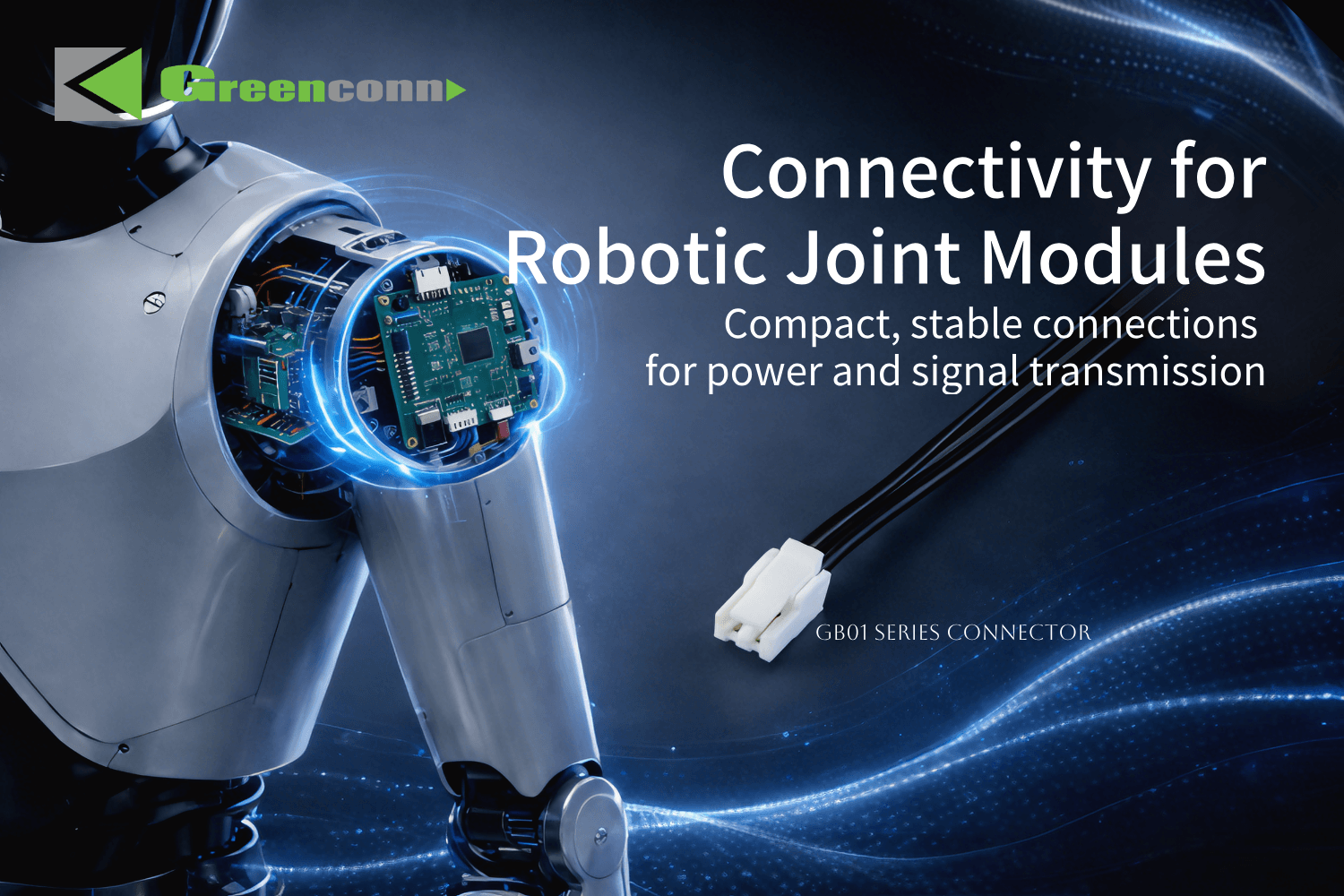
Application of GB01 wire-to-board connector in robotic joint module
In such highly integrated structures, connectors must ensure reliable electrical performance and mechanical retention under space constraints, dynamic movement, and multi-signal transmission conditions.
A typical joint module consists of a motor, gearbox, encoder, and drive control unit, forming a tightly coupled electromechanical system. The contact condition, impedance stability, and vibration performance of interconnection points can influence signal integrity and, consequently, the stability of closed-loop control systems.
Connector Design Considerations in Joint Modules
In humanoid robot joint applications, connectors must address the following engineering constraints:
1. Multi-channel routing and electrical isolation
Joint modules typically carry power, control signals, and encoder signals simultaneously. Parallel routing of multiple channels may introduce crosstalk or coupling, requiring appropriate terminal layout and structural design to mitigate interference.
2. Contact stability under continuous vibration
During operation, joints are subject to repetitive micro-vibrations. The stability of the contact interface is critical to maintaining consistent electrical performance and minimizing transient contact disruptions.
3. Wire harness strain management during motion
Joint articulation leads to repeated flexing of wire harnesses. The connector termination area must provide sufficient strain relief to reduce the impact of long-term mechanical fatigue.
4. Modular assembly and serviceability
Within compact joint structures, connectors must balance space utilization, locking reliability, and ease of assembly and maintenance.
Structural Features of the GB01 Series Wire-to-Board Connectors
To address the requirements of joint module applications, Greenconn’s GB01 series wire-to-board connectors incorporate design optimizations in both structure and contact architecture to support multi-channel, space-constrained, and dynamic operating environments.
l Multi-point contact structure
Multi-contact design enhances contact redundancy and stability, reducing the risk of contact fluctuation under vibration.
l Low contact resistance (≤30 mΩ)
Optimized contact geometry and material selection help control contact resistance, reducing voltage drop along the power path while maintaining stable signal transmission.
l Compact layout (1.25 mm pitch)
The fine-pitch design enables high-density integration within limited space, supporting mixed routing of power and signal lines inside joint modules.
l Vibration-resistant structure with locking mechanism
Mechanical design improvements increase retention force and reduce the risk of accidental disconnection under vibration or shock conditions.
l Customization capability
Supports customized pin assignments, cable configurations, and structural adaptations to meet diverse joint module integration requirements.
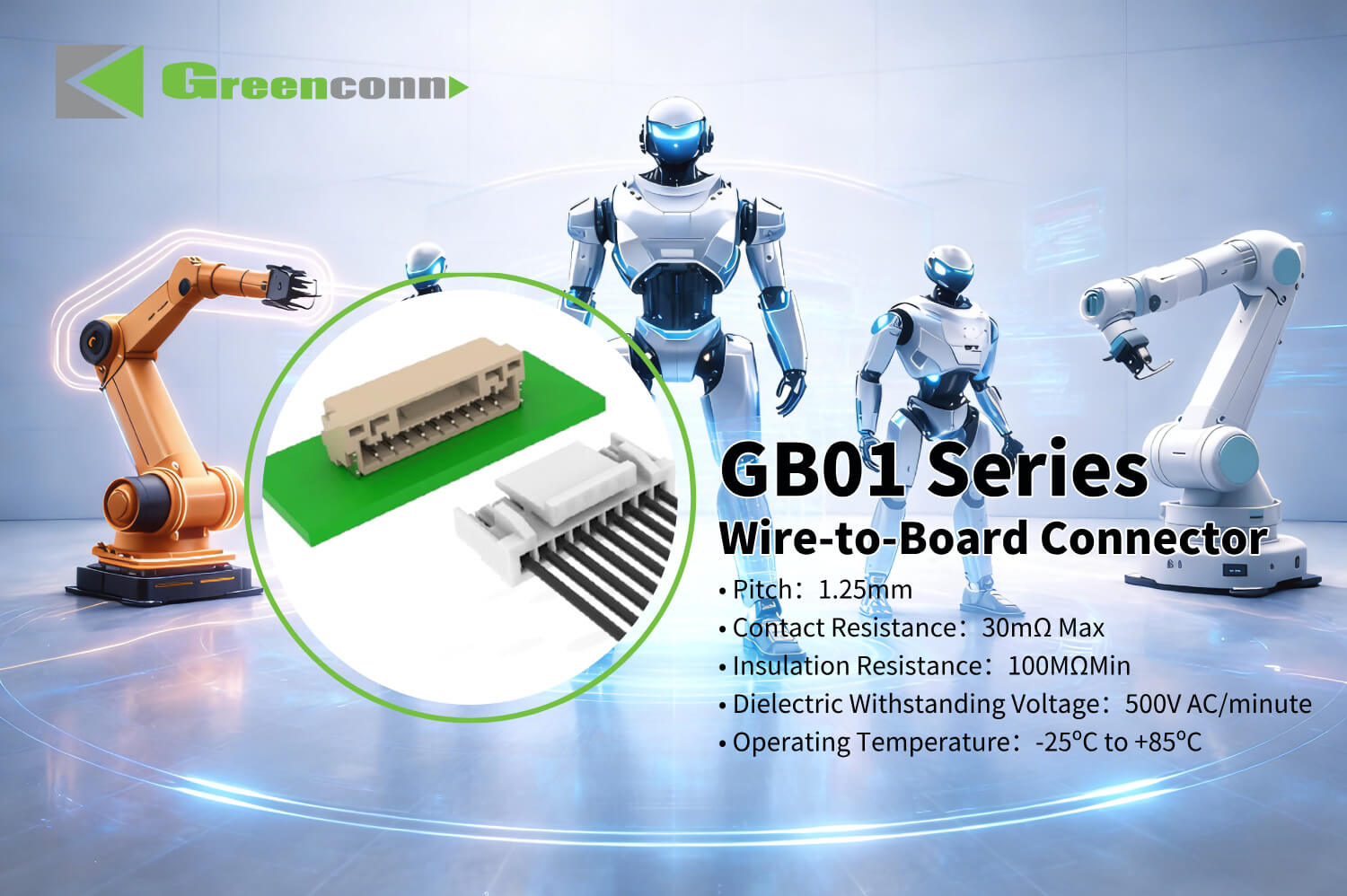
Structure and mating view of GB01 wire-to-board connector
As humanoid robots continue to evolve toward higher dynamics and longer operational lifecycles, joint modules place increasingly stringent demands on connectors in terms of space efficiency, contact stability, and signal integrity. Interconnect design is expected to further progress toward higher density, multi-channel integration, and enhanced reliability under dynamic conditions, enabling integration into increasingly complex mechanical architectures.

